The Himalayan Compute Company

Water falls. Intelligence rises.

Hydropower, cold air, and high ground, turned into intelligence. Built in Nepal. Built for the world. Starting at 50 MW. Built out to 1 GW.

27.7172° N 85.3240° E Kathmandu Elevation 1,400 m N1P1 50 MW, then 1 GW SP/COMPUTE MMXXVI Scroll
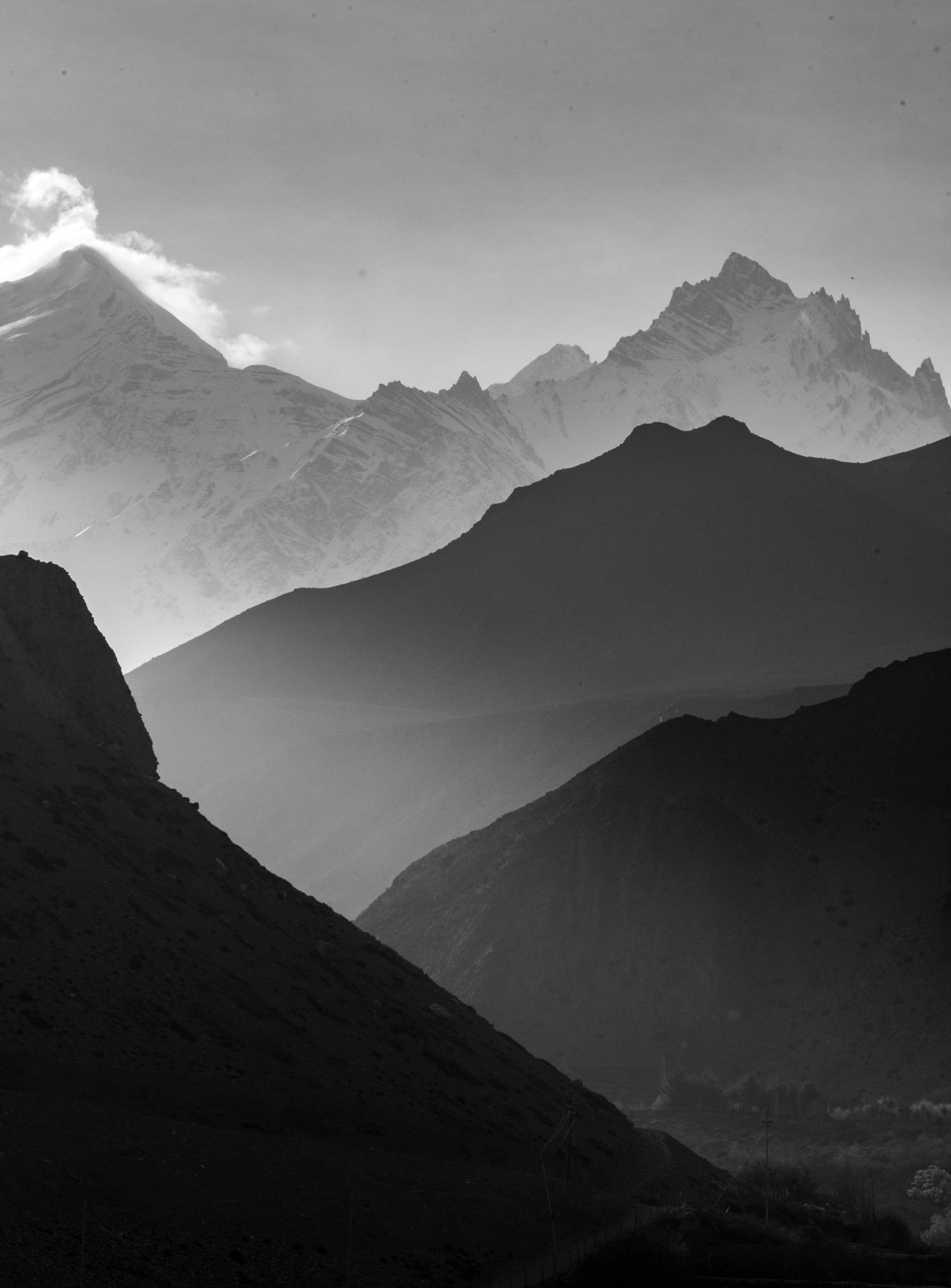
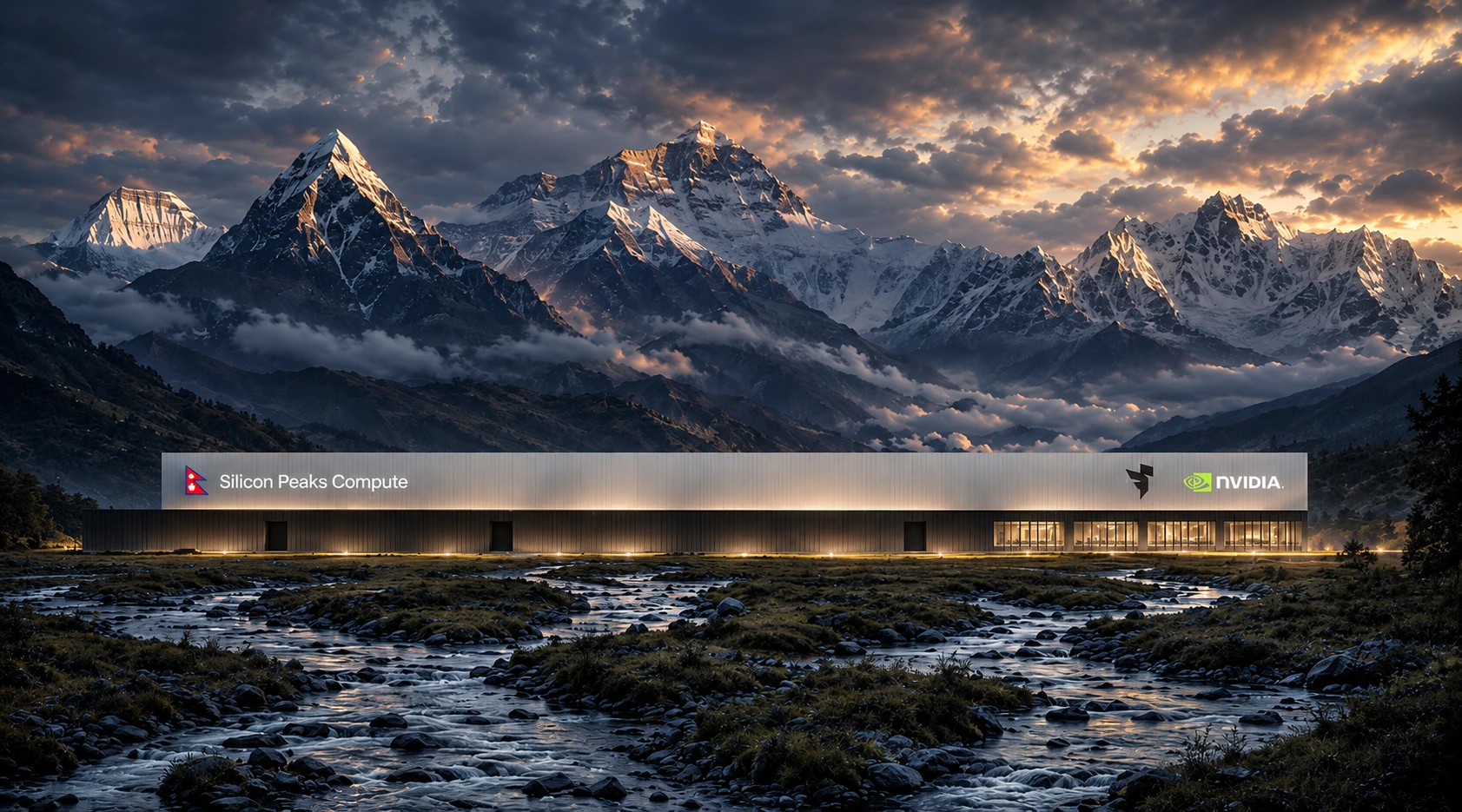
Himalayan peaks rendered landscape

Silicon Peaks Compute

01The demand

World

The world is short of intelligence.

Every serious power is building AI factories the way earlier centuries built ports and railways. The argument about whether is over. What remains is where, and who owns what comes out.

Global data-center power demand is on track for roughly 2,000 GW by 2050 against about 600 GW of committed supply. The 1,400 GW between those numbers is the opening.

Countries that host compute keep their data, their language, and their models at home. Countries that only import intelligence pay rent on their own future.

In their words

Tokens are the new commodity. AI factories are the infrastructure that produces them.

Jensen Huang, NVIDIA, 2026

There will be a significant power shortfall next year, so not like the distant future.

Elon Musk, 2026

We see a future where intelligence is a utility like electricity or water and people buy it from us on a meter.

Sam Altman, OpenAI, 2026

FIG. 01The divergence. Global data-center power, GW

2020 to 2050
DemandCommitted supply

IEA, Energy and AI 2025. Wood Mackenzie. Uptime Institute. Indicative trajectories. REV 2026.09

0GW

demand by 2050

0GW

committed supply

0GW

the opening between them

02The ledger

FIG. 02

What the Himalayas hold.

Roughly 30,000 MW of new hydropower comes online over the next decade, in a country whose peak demand today is about 3,200 MW. Last year Nepal exported 3.9 TWh at about five cents a kilowatt hour.

The same electricity, sold as compute, earns roughly twenty times more.

The mountain ledgerNepal hydropower, GW
Peak demand today3.2 GW Coming online this decade30 GW About 27 GW of that is surplus. Unsold. Theoretical potential100 GW

Nepal Electricity Authority public reporting, FY 2025/26. Under five percent of theoretical potential is built. REV 2026.09

0

rivers and rivulets

0TWh

exported, FY 2025/26, at about $0.05 per kWh

0×

compute ceiling relative to GDP

$0to 7.1T

compute ceiling, Compute Net Worth Index

FIG. 03The spread. Same water, same turbines.

Interactive
Plant size 50 MW
Exported raw, across the border$21.9Mper year at $0.05 per kWh. The monsoon surplus leaving as raw watts.
Sold as compute, kept at home$438Mper year, same electrons, intelligence instead. Jobs, tax base, and models trained on the region's own language stay Nepali.

Indicative. Anchored to Nepal Electricity Authority public reporting and Silicon Peaks' published compute-ceiling analysis, a twentyfold spread. Assumes full utilization at plant rating. Slide from 50 MW, the first node, to 1 GW, the build-out. Not an offer of securities.

03The reach

FIG. 04

Why altitude wins.

A kilowatt hour that starts as falling water at altitude costs less than any other kind, arrives cold, and lands one fiber hop from a quarter of humanity.

The landed kilowattLevelized cost, $ per kWh, 2025
Himalayas, hydro0.03 to 0.05 Nordics, hydro0.03 to 0.06 Iceland, geothermal0.04 to 0.07 India, grid0.07 to 0.10 United States, grid0.10 to 0.18 Singapore, grid0.15 to 0.28

IEA, Electricity 2028. BloombergNEF LCOE Survey H2 2025. Operator filings. Axis runs to $0.30. REV 2026.09

0to 1.3

design PUE, cold climate

0ms

to tier-1 APAC hubs

0B

people within reach of Kathmandu

Reach

Great-circle from Kathmandu

From Kathmandu. Half the planet within reach.

Proximity to 2.5 billion people.

Arcs: Delhi · Kolkata · Dhaka · Mumbai · Bengaluru · Colombo · Bangkok · Singapore · Dubai · Hong Kong · Tokyo · Seoul · Frankfurt · London · San Francisco. Nearby corridors pulse faster.

Gravity is the cheapest form of energy ever discovered.

04On water, since people ask

Closed loop

A 100 MW AI factory uses less fresh water in a year than a neighborhood tea shop uses in three months.

AI factories carry a reputation for consuming a lot of water. That reputation belongs to an older generation of machines. Modern halls run closed loops: fill once, circulate for years, like the radiator of a car.

The drinking taps stay untouched.

Water

The myth

Data centers drain municipal water and dry village wells.

The fact

Closed loops fill once and recirculate. Daily draw from drinking supplies is near zero. A year of operation uses less water than a small village pond holds.

Power

The myth

AI factories steal electricity from homes and bring back load shedding.

The fact

They fund their own substations and transmission, and they buy the monsoon surplus that today spills past the turbines unsold.

Jobs

The myth

Server halls are empty warehouses that occupy land and employ nobody.

The fact

Construction employs thousands. Operations sustain high-skill engineering careers for decades, and the tax bill supports a district.

The full record on modern data centers →
THE HIMALAYAN COMPUTE COMPANY

01 THE DEMAND

From Kathmandu. To the world.

Nepal: local-language AI, universities, startups and public-service applications.

South Asia and APAC: regional inference, enterprise workloads and research.

Global customers and off-takers: AI platforms, multinationals and dedicated compute capacity.

Kathmandu · South Asia · APAC · Global markets
02 THE ECOSYSTEM

Global technology. Local execution.

Delivering compute takes an ecosystem: technology, capital, the expertise to build and operate, and customers who need the capacity.

Silicon Peaks is bringing those pieces together around a facility in Nepal.

Technology · Delivery · Operations

03 THE FACILITY

One facility. Every layer accounted for.

Compute, cooling, power distribution and connectivity, designed as one coordinated environment for running AI workloads.

Each system has a clear role. Their integration turns individual components into useful capacity.

Silicon Peaks Compute

04 THE COMPUTE

Where power becomes useful work.

Accelerators do the computation. Memory keeps the working data close. High-speed connections let machines operate as one system.

A representative server tray opens to reveal the relationship between the chip and its coldplate.

Accelerators · Memory · Internal network

05 THE COOLING

Follow the heat.

Cooling starts at the chip. Liquid carries heat through the cooling circuit to distribution and heat-exchange equipment.

Compute, liquid cooling and the power system stay connected as the facility opens.

Chip · Coldplate · Coolant loop · Heat rejection

06 THE FOUNDATIONS

Water. Power. Fiber.

Below the city sit the physical foundations: land, water infrastructure, the power interface and optical fiber.

Those foundations connect the facility to the resources it needs and the customers it serves.

Land · Water · Energy · Connectivity

07 THE OPPORTUNITY

More opportunity. Built in Nepal.

Foreign direct investment. Multinationals. Local enterprise. An ecosystem for builders, skilled work and new businesses.

The ambition is lasting economic progress: stronger productivity, better jobs, and a greater contribution to Nepal's GDP.

FDI · Multinationals · Jobs · Economic growth

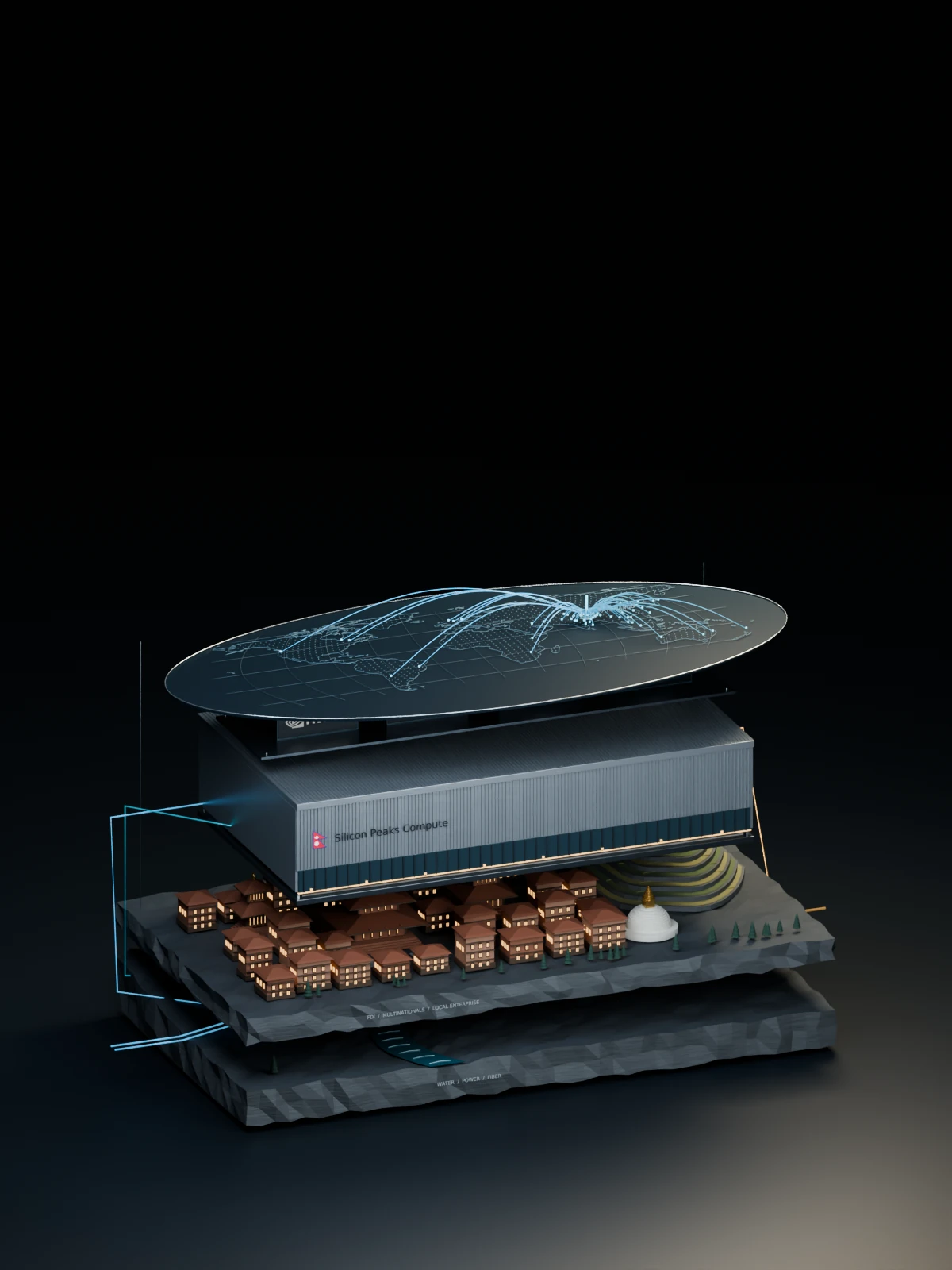
08 THE COMPLETE SYSTEM

Built in Nepal. Connected to the world.

Customers, partners, a purpose-built facility, Kathmandu's enterprise and the foundations beneath it.

Each part makes the others possible. Together, they connect Nepal's resources and talent to the world's demand for intelligence.

One connected system.

The complete Silicon Peaks ecosystem, with Kathmandu above its utility foundations
KATHMANDU, NEPALCONNECTED TO THE WORLD
WATER. POWER. INTELLIGENCE.ONE COMPLETE SYSTEM

Routes are illustrative audience connections, not contracted capacity or measured latency. FDI, jobs and GDP are ambitions, not forecasts. NVIDIA is the only legible partner mark, shown at our direction; visibility is not a verified commercial claim. Other partners remain anonymized.

06Phase 1

N1P1

N1P1 is Himalayan 1.

The first node. What can be said is below. The rest stays under NDA.

Already in motion. No names and no logos, by design. Just the shape of the room.

HyperscalersIn dialogue
Leading AI firmsIn dialogue
Fortune 500In dialogue
Global 2000In dialogue
The ramp50 MW → 1 GW · years
50 MWN0P1 // Himalayan I // H2 2027
250 MWHimalayan II // 2028
1 GW2029
50MWN1P1, Himalayan 1. The first node.
1GWThe build-out, over five years.
8,000+Tier 1 chips for phase 1.
StealthPartners, offtake, and chip supplier stay under NDA.
NVIDIA

Some things in the infrastructure of the coming century will be built once.

07The people

Names on request

Silicon Peaks Compute is Nepali. And Built For The World.

Four founders, born in Nepal. Educated at the world's top universities, trained in Silicon Valley and on Wall Street, now building at home. Names on request.

A·T

Kathmandu

L·M·B

Kathmandu

P·C·H

San Francisco

R·A

Miami

Educated & trained at

  • Harvard
  • Stanford
  • Columbia
  • Brigham Young
  • Heidelberg
  • NUS Singapore
  • Tribhuvan, Pulchowk

We work under mutual NDA from first contact.

$0B+

enterprise value built at prior companies

0+

years of operating experience

0

prior exits

08Inquire

48 hours, mutual NDA

Three lanes. One inbox.

One paragraph on who you are and what you hold or need. We reply within forty-eight hours, under mutual NDA.

founders@siliconpeaks.ai

Every reply under mutual NDA. Kathmandu. San Francisco.

09Common questions

FAQ
What is Silicon Peaks?

Silicon Peaks is the idea that the Himalaya can be for the intelligence age what Silicon Valley was for the software age: a technology hub where clean power, cold air, high ground, and a young technical workforce concentrate. Anchored in Nepal, it serves South Asia and the Asia-Pacific with compute, jobs, and an ecosystem the region currently imports.

What is Silicon Peaks Compute?

A Nepali company, incorporated in Delaware, building AI compute infrastructure where Himalayan water power is abundant, clean, and cold. We work with partners and governments under NDA. In short: the Himalayan Compute Company.

Why Nepal?

Upwards of 100,000 MW (100 GW) of theoretical hydropower with under 5 percent built, cold air at altitude, and 1.4 billion neighbors one fiber hop away. The inputs of the intelligence age sit in one geography.

How much water does an AI factory use?

Less fresh water in a year than a neighborhood tea shop uses in three months. The water circulates in sealed pipes like the radiator of a car, and the drinking taps stay untouched.

How do I reach the team?

Write to founders@siliconpeaks.ai with one paragraph on who you are and what you hold or need. Replies within 48 hours, under mutual NDA.

Where is the company based?

Silicon Peaks Compute is a Delaware corporation with a dual base: Kathmandu for land, power, and build; San Francisco for capital and governance.